The Idea
The single biggest complaint that the BBC Weather Centre receives is that 'They've got it wrong'.
Understandably, they get a bit fed up with this.
Let's use the combined power of disgruntled 'I Think You'll Find's' all over the country to produce the world's first democratic. distributed, user-generated, community weather reports.
It's like Michael Fish meets Seti@Home meets del.icio.us... Or something.
The Screenshot
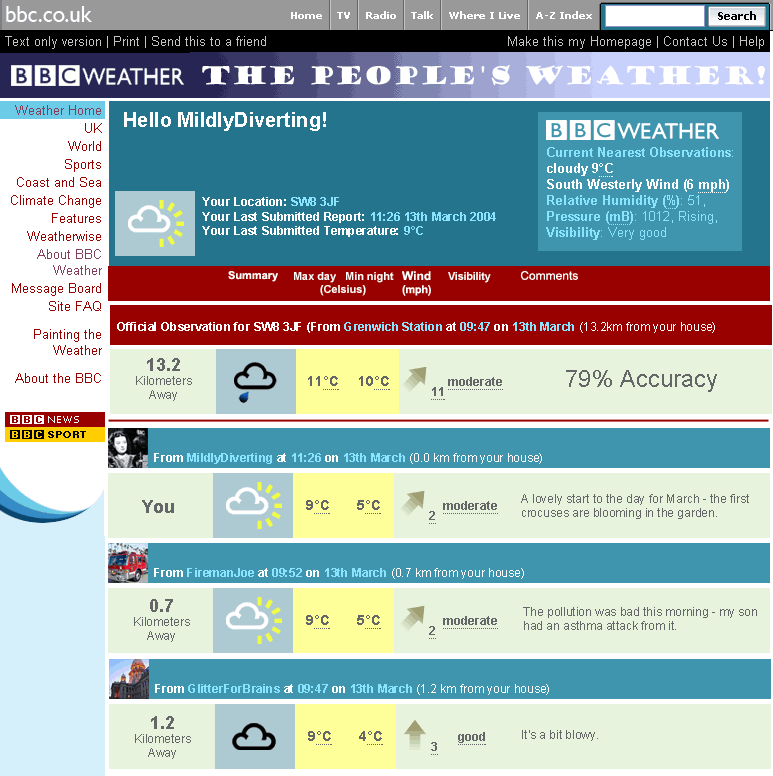
The Method
- User accesses the 'complain' feature on the weather site.
- They get a call to action: "Are you telling us that our forecast is wrong? Why not help us out by joining 'The Peoples' Weather'?"
- User registers for The Peoples' Weather - they give their address and postcode to precisely locate them in the UK.
- Their postcode and address data is transformed into a Lat/Long measurement
- They are sent a simple, cheap, accurate thermometer and anemometer to install in their garden / on their balcony / wherever.
- The user downloads a simple desktop application...
- Launches on startup
- Displays weather information in a dialog accessed from the desktop, using weather RSS feeds.
- Has a 'correct us!' button underneath the forecasts.
- Allows user to choose an alternate 'weather symbol' to accurately reflect the weather conditions in their particular microclimate.
- Allows the user to enter their thermometer/anemometer reading.
- Feeds the user generated weather data back to the BBC weather centre.
- Displays an average of the most recent reports from the local area along side the official weather.
- User submitted weather data is aggregated in realtime for each postcode area. This is then displayed, where available, along side the official weather for that region.
- The People's Weather also feeds back to the desktop aggregators, showing the official forecast alongside the averaged forecast for that area.
- Users are credited if their weather report is used to generate any 'People's Weather' served.
- Variances between the predicted weather conditions and the reported weather conditions for each area can then be plotted over time, using any number of completely insane flash-based graphs and charts.
- The user gets the satisfaction of seeing their BBC weather with 'This is probably only 79% right...' next to their forecast, and knowing that they corrected the BBC.
The Application:
The Possibilities
Users can submit one-day and five day forecasts, which are then judged for accuracy against the aggregated results for their local area. Users with high percentage correctness get kudos and prizes. Their forecasts carry more weight in the aggregation as a result.
Schools get involved - it's a way of getting kids interested in weather, learning more about the art of weather prediction, and it's fun. This gives us a greater volume of data, and teachers help to filter the data for glaring inaccuracies...
Build your own weather station: the BBC provides simple instructions for automating your weather station - linking it direct to your PC. The availability and accuracy of forecasts benefits.
Mobile - an application is developed that uses cel location and some phones onboard thermometers to allow for weather reporting on-the-go.
Screensavers - changing to show the weather conditions in areas of your choice, or an ever-shifting map of reports.
More stuff as I think of it...